how-to
Engineering Proposal Quality Review Checklist for Public Works Bids
Editorial Team · 2026-11-27 · 13 min read

Last Updated: November 26, 2026
Quick Summary
An engineering proposal quality review checklist should cover solicitation compliance, technical accuracy, scope and deliverables, risk and assumptions, and submission readiness. A checklist works when it maps every solicitation requirement to a named reviewer and a pass/fail test.
- Run reviews in four stages: kickoff and requirements extraction, technical review, compliance and editorial review, and final sign-off.
- Build a traceability matrix before drafting, logging each requirement with a stable ID, owner, evidence, and pass/fail result.
- The engineer who wrote the technical approach should never be the only person who reviews it.
- Score your own draft against the agency's published evaluation criteria and record the evidence behind each score.
- An exclusion left out of the proposal to keep it clean becomes an unpriced obligation after award.
Table of Contents
- What should an engineering proposal quality review checklist cover?
- Running the engineering proposal review process from kickoff to sign-off
- Building a proposal compliance checklist against the solicitation
- Engineering proposal evaluation criteria that decide the score
- The working engineering proposal review checklist
- Common mistakes that sink public works proposals
- Putting the checklist to work on your next pursuit
- Frequently Asked Questions
What should an engineering proposal quality review checklist cover?
An engineering proposal quality review checklist should cover solicitation compliance, technical accuracy, scope and deliverables, risk and assumptions, and submission readiness. By checking engineering project quality against the proposal’s stated standards, reviewers can distinguish essential workmanship safeguards from assumptions that may expose the project to avoidable cost.
A real checklist is not a general reminder to "review the proposal." It is a set of specific, answerable questions tied to the document in front of you. A scoping review of checklist design approaches in healthcare organizations notes that good checklist guidance starts with existing literature and then accounts for the skills, experience, and context of the people who will use it.
Here is what a working engineering proposal quality review checklist covers:
- Compliance: every solicitation requirement, answered and cross-referenced
- Technical validity: design criteria, specifications, and constructability
- Scope and deliverables: what you promised, in what quantity, by when
Below, we break down how to run the review, who signs off, and what to check at each stage.
Running the engineering proposal review process from kickoff to sign-off
A disciplined engineering proposal review process runs in four stages: kickoff and requirements extraction, a technical review, a compliance and editorial review, and a final sign-off. Each stage has a named owner and a fixed cutoff. Reviews that run as one big meeting at the end catch formatting errors and miss substance.
Here is the sequence we recommend:
- Kickoff (day one). Read the solicitation as a team. Extract every requirement into a compliance matrix.
- Draft review (mid-pursuit). Technical leads check scope, approach, and design criteria against the draft.
- Compliance and editorial pass. A reviewer who did not write the section checks forms, page limits, headings, and cross-references.
- Red team read. Someone outside the pursuit reads for gaps and scoring risk.
- Sign-off. One authorized person confirms the package is complete and submits.
Timing is where pursuits fall apart. Review windows shrink when the team is still writing. guidance on tracking public solicitation deadlines helps here, because the review calendar has to hang off the agency's actual due date, not an internal guess.
For a fuller walkthrough of the workflow itself, see 7 Steps to Simplify Your Engineering RFP Workflow.
Assigning review roles and keeping technical review independent
Independence is the part most teams skip. The engineer who wrote the technical approach should not be the only person who reviews it. Assign four roles:
- Proposal manager: owns the schedule and the compliance matrix
- Technical reviewer: checks design criteria, specifications, and methodology
- Compliance reviewer: checks forms, page limits, and submission rules
Small teams can combine roles, but never merge the technical reviewer with the author. If your team is short on staff, How to Build a Public Works Proposal Workflow for Small Teams shows how to assign roles without a large review bench.
Building a proposal compliance checklist against the solicitation
A proposal compliance checklist is a line-by-line table of every requirement in the solicitation, with columns for where the proposal answers it, what evidence proves the answer, who confirmed it, and whether it passed. Build it before anyone writes a word.
The step most teams skip is turning the checklist into a traceability matrix. A plain checklist tells you a requirement exists.
Extracting requirements from the solicitation
Start by pulling requirements out of the solicitation itself, not a summary or a Q&A digest. Read the instructions to offerors, the evaluation criteria, the scope of work, and every attachment, form, and referenced standard.
A practical extraction sequence:
- Instructions to offerors. Page limits, font, margins, file types, required forms, submission portal, and the agency's response deadline. Log each as a separate requirement.
- Evaluation criteria. Every scored factor and subfactor, with its published weight if the solicitation states one. These become review priorities, not just compliance lines.
- Scope of work and technical requirements. Design criteria, standards to be cited, deliverables, quantities, and formats.
- Attachments and referenced documents. Forms, certifications, bonding and insurance evidence, and any standard the solicitation incorporates by reference.
- Amendments and addenda. Re-read the issuing agency's solicitation page before sign-off and reconcile any addendum against the matrix. An addendum that changes a form or a deadline invalidates the version built before it.
Watch out: extracting from a summary instead of the solicitation is how a requirement gets answered in the wrong section or dropped entirely, and the error usually surfaces only after the agency's deadline has passed.
The traceability matrix columns
Use the same column structure on every pursuit so reviewers do not have to relearn the document. A workable set:
| Column | What it records |
|---|---|
| Requirement ID | Stable label (for example, R-014) tied to the solicitation section |
| Requirement text | Short paraphrase plus the solicitation citation |
| Proposal location | Section, page, or attachment where the answer lives |
| Evidence | Form, exhibit, chart, or narrative passage that proves the answer |
| Owner | Named person accountable for the answer |
| Reviewer | Named person who confirmed it |
| Pass/fail | Result against a stated test, not a subjective impression |
| Notes | Open issues, addendum references, and resolution date |
Two columns do the most work. The evidence column forces the team to point at something concrete rather than a promise, and the pass/fail column forces a decision instead of a comment. A requirement with no evidence is not passed; it is open.
A worked illustrative example
Suppose a solicitation requires a project schedule in a specific format and a named project manager with a stated availability commitment. The matrix rows might read:
- R-021, schedule format. Requirement: schedule in the agency's provided template, submitted as a separate attachment. Proposal location: Attachment C. Evidence: completed template. Owner: proposal manager. Reviewer: compliance reviewer. Pass/fail: pass after the template is confirmed against the current addendum.
- R-022, project manager availability. Requirement: named project manager with a stated percentage of availability during the contract period. Proposal location: staffing section, paragraph 3, and the staffing table. Evidence: resume plus a signed availability letter. Owner: technical reviewer. Reviewer: proposal manager. Pass/fail: open until the availability letter is signed.
This example is illustrative, not drawn from a specific solicitation. Each row names a document a reviewer can open, not a general assurance that the team addressed the topic.
Separating compliance review from technical review
Compliance review asks one question: did we answer what the solicitation asked, in the format it asked for?
Run compliance first. There is no point polishing technical content in a section the solicitation did not request.
Bonding and insurance are common compliance items that get missed. 7 Public Works Bonding and Insurance Requirements to Know covers the categories to verify against the solicitation.
Engineering proposal evaluation criteria that decide the score
Engineering proposal evaluation criteria are the weighted factors the agency publishes to score submissions. Reviewers should read them before the first draft, because they tell you where to spend review time.
Most public works solicitations publish their criteria in the solicitation or in the evaluation section of the instructions. Common categories include technical approach, team qualifications, past performance, schedule, and price.
Turning published criteria into a scoring rubric
The gap most review processes leave open is the step between reading the criteria and testing the draft. Build a scoring rubric that mirrors the agency's published factors and subfactors, then score your own draft against it before submission.
A simple five-point scale per factor works for most pursuits:
- 5, exceeds. Evidence is specific, quantified where the criterion allows, and directly responsive.
- 4, strong. Evidence is specific and responsive with minor gaps.
- 3, adequate. Evidence is responsive but general.
Score each subfactor, not just the top-level category. A strong technical approach score can hide a weak schedule subfactor, and the agency will score the subfactor.
Pass/fail gates before scoring
Scoring is only meaningful after the proposal clears the gates that make it evaluable at all. Define pass/fail gates separately from the rubric, because a proposal that fails a gate is not scored lower; it is set aside.
Common gates:
- Responsiveness gate. Every mandatory requirement in the traceability matrix is answered and evidenced.
- Format gate. Page limits, font, margins, file types, and required forms match the solicitation and any current addendum.
- Signature gate. Every form requiring a signature is signed by an authorized signer.
Watch out: a proposal that fails a gate can still look polished, so reviewers who only score content will pass it and the failure surfaces at the portal.
Weighting review effort to the criteria
Once the rubric exists, use it to allocate review time. A factor carrying a large share of the published score gets a dedicated reviewer and a second read.
Two rules follow from this:
- Score your own draft against the published rubric. Have the red team assign scores and record the evidence behind each score before submission.
- Review to the criteria, not to your preferences. A beautifully written section that does not address a scored criterion earns nothing, and a plain section that answers the criterion with specific evidence earns full marks.
Record the rubric scores alongside the traceability matrix so the final sign-off covers both responsiveness and scoring risk. A proposal can be fully compliant and still score poorly, and the rubric is how you catch that before the agency does.
The working engineering proposal review checklist
The working engineering proposal review checklist is the reusable document your team runs on every pursuit. Keep it short enough that reviewers actually use it.
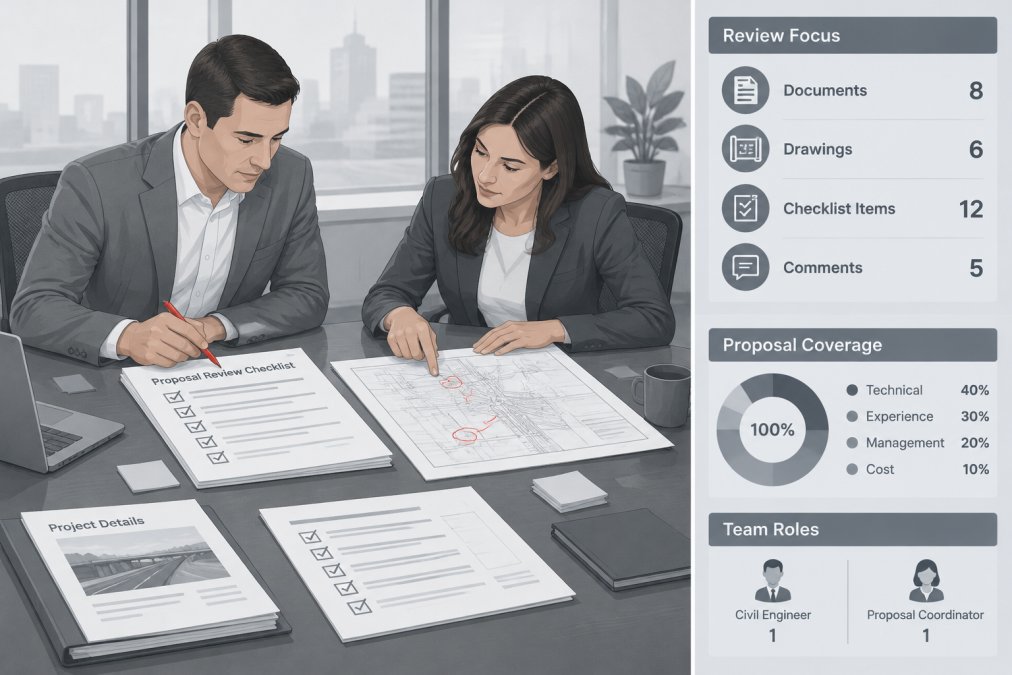
- Deliverables are named, with quantities and formats
- Design criteria are stated and match the project requirements
That last item is a consistency check, not a technical one. A schedule that assumes staff the staffing plan does not commit is a scoring risk.
Risk, assumptions, exclusions, and liability review
Risk review is the step that protects the firm after award. Reviewers should confirm that assumptions are stated, exclusions are clear, and the terms you are accepting are terms you can perform under.
Check these items:
- Assumptions are listed and tied to specific scope items
- Exclusions are stated plainly, not buried
- Liability and indemnification terms are reviewed against firm policy
Watch out: an exclusion left out of the proposal to keep the document "clean" becomes an unpriced obligation after award. State it.
Common mistakes that sink public works proposals
The most common mistakes in public works proposals are missing forms, page-limit violations, scope that does not match the solicitation, and technical content that contradicts the fee proposal. None of these are engineering failures. All of them are review failures.
The recurring ones we see:
- No compliance matrix. Requirements get answered in the wrong section, or not at all.
- Review too late. The review happens after the document is "final," so findings get argued instead of fixed.
- Same person reviews everything. Independence disappears and errors survive.
For a broader look at what moves win rates, How to Improve Government Bid Win Rates: A Practical Guide covers the patterns behind recurring losses.
Putting the checklist to work on your next pursuit
The checklist only earns its keep if it runs before the deadline crunch, not during it.
Project Signals does not write or submit proposals, and does not guarantee awards or outcomes. It reduces portal-by-portal searching and gives your review team a starting point.
A quality review is only as good as the opportunity it is reviewing. If your team spends Friday afternoons checking portals one by one, that is review time lost.
Frequently Asked Questions
What is the difference between a technical review and a compliance review?
A compliance review checks the proposal against the solicitation's stated requirements: forms, sections, page limits, submission format, and required attachments. A technical review checks whether the engineering content is correct, buildable, and consistent with the scope and deliverables. Both belong on a proposal review checklist, but different reviewers should own them. Compliance reviewers work from the RFP text; technical reviewers work from the design criteria, specifications, and project requirements. Running them as separate passes catches more errors than one combined read-through.
How do you evaluate an engineering proposal against the RFP?
Start by building a compliance matrix that maps every solicitation requirement to a specific proposal section, then score each response against the evaluation criteria the agency published. Check that the scope of work, deliverables, schedule, and staffing plan match what the RFP asks for, and confirm assumptions and exclusions are stated clearly. A proposal review checklist should include a final cross-reference pass so reviewers can trace each requirement to a page. Where the agency publishes a scoring rubric, mirror it in your internal review so gaps surface before submission.
What should reviewers check before an engineering proposal is finalized?
Before finalizing, reviewers should confirm submission readiness: correct project name and client details, page numbering, hyperlinks and cross-references that resolve, tables and graphics with captions, and consistent terminology and headings. On the technical side, verify scope and deliverables against the RFP, check that the project approach and methodology are internally consistent, and review risk, assumptions, and exclusions for anything that could create liability. Assign one reviewer to sign off on each area so nothing depends on a single last-minute read.
How can a team check an engineering proposal against an RFP?
Use a two-pass approach. First, a compliance reviewer builds a requirement-by-requirement matrix from the solicitation and marks each item as met, missing, or unclear. Second, a technical reviewer reads the proposal against the design criteria, specifications, and scope of work. Keep the matrix open during both passes so technical changes do not break compliance. Project Signals can centralize the official solicitation documents, deadlines, and pursuit notes in one workspace, which makes that cross-check easier, but the review itself stays with your team.
