blog
Evaluating Government Bid Platform Data Accuracy
Editorial Team · 2026-10-18 · 14 min read

Table of Contents
- Why Bid Platform Data Accuracy Decides Your Bid/No-Bid Call
- Government Bid Data Sources: What a Platform Should Actually Monitor
- Government Bid Platform Coverage: Reading the Fine Print
- Government Procurement Data Quality: The Five Attributes That Matter
- How to Verify Government Solicitations Before You Commit a Team
- A Repeatable Audit Checklist for Validating Platform Records
- Scoring Platforms: A Practical Procurement-Platform Scorecard
- Conclusion
- Frequently Asked Questions
Last Updated: October 18, 2026
Why Bid Platform Data Accuracy Decides Your Bid/No-Bid Call
Bid platform data accuracy is the degree to which a monitoring service's opportunity records match the official solicitation documents published by the issuing agency.
A bid/no-bid decision is only as good as the record it sits on. One stale deadline can tie up an estimator for a week; one misread scope can put a proposal team on the wrong project.
Below is how to test a platform's records before you trust them.
Government Bid Data Sources: What a Platform Should Actually Monitor
A credible platform monitors a defined list of public sources and tells you what that list contains.
Government bid data sources fall into four broad groups:
- Federal contract opportunities, published through the government's official procurement systems
- State agency solicitations, often split across transportation, water, and general services departments
- Planning and forecast documents, which signal future work but are not open solicitations
That last group matters: a forecast notice tells you a project is coming, not that a contract is open for bids.
The federal contracting resources at USA.gov explain how federal opportunities are officially posted. Compare that against what a vendor claims to monitor.
Government Bid Platform Coverage: Reading the Fine Print
Coverage claims deserve the same scrutiny as a scope of work. "Nationwide" and "all agencies" are marketing phrases, not specifications.
Ask three questions before you accept any coverage claim:
- Which named sources does the platform monitor in each state?
- Which disciplines are actually reviewed, and by whom?
- Which delivery roles does the matching support, prime or subcontractor?
An available state does not mean every agency inside it is covered.
Project Signals publishes source depth by state and discipline for this reason. You can review current coverage on our markets and coverage pages before you commit.
The practical test: pick two agencies you bid to regularly and ask the vendor to show you records from both, with dates.
Government Procurement Data Quality: The Five Attributes That Matter
Government procurement data quality comes down to five measurable attributes. Score each one for a defensible comparison, but define pass and fail before you start.
| Attribute | Working Definition | Concrete Test |
|---|---|---|
| Accuracy | Record matches the official notice on every field you rely on | Compare title, agency, response deadline, and scope summary against the issuing agency's page |
| Completeness | Key fields are populated, not blank or placeholder | Count blanks in scope, deadline, contact, and solicitation-number fields |
| Freshness | Record reflects the latest agency action, including addenda | Compare the platform's last-updated date to the agency's addenda log |
| Provenance | Source and issuing agency are named and linked | Confirm every record links to an official agency page, not a mirror |
| Consistency | Same fields, same format, across sources | Compare a federal record and a local record side by side |
Accuracy and completeness get the attention; freshness is where most platforms quietly fail. An agency issues an addendum that moves a deadline, the platform still shows the original date, and nothing looks broken, so nobody checks.
Turn Each Attribute Into a Number
A pass/fail label is not enough to compare two platforms. Define field-level error rates so you can report a percentage, not an impression.
- Field-level error rate: the share of sampled records where a specific field (deadline, agency, solicitation number, scope summary) is wrong. Report it per field, not blended.
- Record completeness rate: the share of sampled records with all required fields populated.
- Duplicate rate: the share of sampled records that appear more than once in the feed under different identifiers.
A blended score hides the problem: a platform can score well overall and still fail freshness on every state transportation record, exactly the segment you bid. Report per attribute and per source.
Sample Size and Method
Eyeballing the feed tells you nothing you can defend in a procurement review. Use a repeatable sample.
- Draw at least 20 records per quarter: 10 from your highest-volume source, 10 spread across other sources and disciplines.
- Include at least 3 records you know were amended, and 2 you know were cancelled or reissued.
- Score each record pass or fail on accuracy, completeness, freshness, and provenance.
Twenty records is not a statistical audit, say so in your notes. It is a consistent sample you can repeat and compare quarter over quarter.
Cross-Checking Against Official Sources
The agency's own page is the source of truth; the platform is a finding aid. For each sampled record, confirm:
- The solicitation or contract number matches.
- The issuing agency and office match.
- The response deadline and time zone match.
- Any addenda issued after the platform's last update are reflected.
- The record is labeled as an open solicitation, a forecast, or an award, not blurred together.
- Any dollar figure shown is labeled as a budget estimate or a guaranteed contract value.
That last distinction trips up experienced teams. A published budget estimate is not a guaranteed contract value, and a forecast notice is not an open solicitation. If the platform does not label the difference, treat it as a data quality failure.
Provenance is the cheapest attribute to audit. If a record does not name its issuing agency and link to the official source, set it aside rather than scoring the other four attributes.
How to Verify Government Solicitations Before You Commit a Team
Verifying government solicitations is a five-minute habit that protects weeks of proposal effort. The rule: the agency's own page is the source of truth, and the platform is a finding aid.
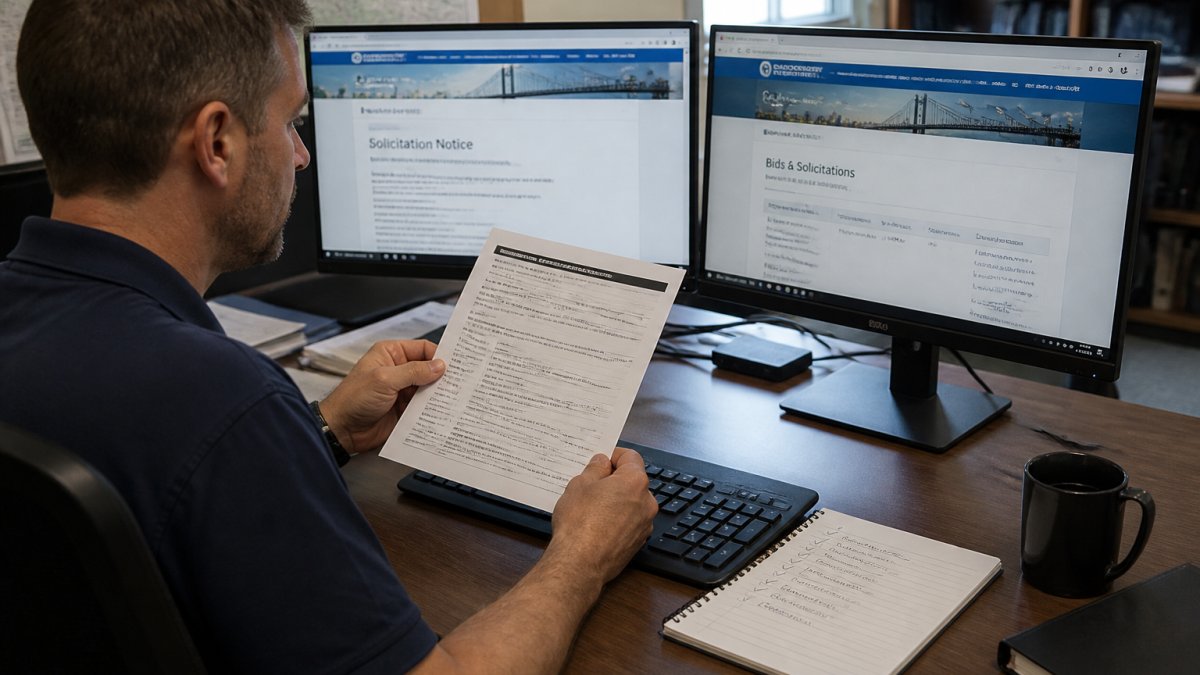
Run this check on every opportunity before you assign staff:
- Open the official notice from the platform record
- Confirm the response deadline and time zone on the agency page
- Check for addenda issued after the platform's last update
Two distinctions trip up experienced teams: an agency response deadline is not the same as a prime contractor's quote deadline when you are chasing subcontract work, and a published budget estimate is not a guaranteed contract value.
Label both clearly in your notes. Your bid/no-bid call depends on it.
A Repeatable Audit Checklist for Validating Platform Records
An audit you repeat quarterly tells you whether the platform is holding its standard. Run this checklist against any trial or renewal.
Before You Start
- Pick a sample window (for example, the last 90 days) and stick to it across platforms so comparisons are fair.
- Pull a random sample of records across sources and disciplines, not just the ones that look interesting.
- Keep a copy of each official agency page as you verify it, with the date you checked. Agency pages change, and your notes are your evidence.
The Field-Level Checklist
Run every sampled record through these checks and mark pass or fail on each line:
- Solicitation or contract number matches the official notice
- Issuing agency and office match
- Response deadline and time zone match the agency page
A record that fails the provenance line should be set aside rather than scored on the other lines. You cannot verify what you cannot trace.
Testing Freshness and Change Tracking
Freshness is the hardest attribute to test because it requires waiting. Build the test into your trial:
- Pick three records you know are active and likely to change.
- Note the platform's last-updated date for each.
- Check the agency page weekly for addenda, cancellations, or deadline changes.
- Record the number of business days between the agency action and the platform reflecting it.
Platforms often reflect new solicitations quickly but lag on amendments and cancellations, leaving a stale record looking current. If the platform shows no last-updated date, treat that as a freshness failure by default.
Handling State, Local, and Federal Differences
Federal opportunities are published through centralized official systems, so federal coverage is relatively easy to verify. State and local sources are fragmented, transportation, water, and general services departments often publish separately, and some agencies post only PDFs or portal listings.
When you audit a state record, confirm which named source the platform monitors. An available state does not mean every agency inside it is covered; a platform can list a state and still miss the transportation department that issues most of the bridge work you care about.
Tracking Results Over Time
Track three measures quarter over quarter:
- Pass rate by attribute and by source, not one blended number
- Update latency, meaning the gap between an agency posting a change and the platform reflecting it
- Blank-field rate on scope, deadline, and contact fields
If latency grows, the review process is slipping. If blank-field rates climb, coverage is widening faster than curation. Either trend is a signal to ask the vendor what changed.
Project Signals keeps a person in the review loop for this reason: matching to your states, disciplines, and delivery roles is only useful if the underlying record is right.
Scoring Platforms: A Practical Procurement-Platform Scorecard
A scorecard turns a sales conversation into a comparison. Weight the criteria by what drives your pursuit decisions, then score each provider from 1 to 5.
| Criterion | Weight | What a 5 Looks Like |
|---|---|---|
| Source disclosure | 20% | Named sources listed by state and discipline |
| Record accuracy | 20% | High pass rate on your own spot-check sample |
| Freshness and change tracking | 15% | Addenda reflected promptly, with dates shown |
| Matching quality | 15% | Filters by discipline and delivery role, not keywords alone |
| Provenance | 10% | Every record links to the official agency page |
| Workflow support | 10% | Notes, deadlines, and pursuit status in one place |
| Pricing transparency | 10% | Clear model, no hidden coverage tiers |
Two notes on using it. Score matching quality by testing it, not by reading the feature list, keyword and role-aware matching produce very different feeds. And treat pricing transparency as a data quality question: a vendor that will not explain what you are buying is telling you something.
On pricing specifically, Project Signals does not publish a flat figure because scope depends on the states, disciplines, and delivery roles you select. Ask for a quote tied to your actual coverage rather than a headline number.
Conclusion
The hard part of platform evaluation is not the demo. It is the discipline of testing records against official sources and repeating that test over time.
Start with the audit checklist above and one amended solicitation. If the platform handles that correctly, widen the test.
Project Signals was built for this kind of scrutiny. We disclose source depth by state and discipline, match opportunities to your delivery roles, and keep official context attached to every record so your team can verify before it commits.
Frequently Asked Questions
How can you tell whether a government bid platform has accurate data?
Sample a set of records and check each one against the issuing agency's own posting. Confirm the solicitation number, title, response deadline, and status match. Then look for disclosed source depth: a platform that tells you which agencies and document types it monitors in each state is easier to audit than one that claims broad coverage without specifics. Bid platform data accuracy is a verifiable property, not a marketing claim, so ask for the source list and test it yourself.
How do you verify a solicitation is still open?
Open the notice on the issuing agency's procurement page and read the current status and response deadline there, not on the aggregator. Check for amendments, cancellations, or re-postings, and note the agency's time zone for the deadline. If the platform record and the agency record disagree, trust the agency. Record the date you checked, because a notice that was open last week may have closed since.
What is the difference between a forecast notice and an open solicitation?
A forecast or planning notice signals that an agency expects to procure something, often months ahead, and carries no guarantee of timing, scope, or budget. An open solicitation is an active request with a defined scope and a response deadline you can bid against. Treat them differently in your pipeline: forecasts feed early pursuit decisions and teaming conversations, while open solicitations drive proposal work. Mixing the two inflates your pipeline and wastes review time.
How often should government bid listings be updated?
Listings should reflect the agency's posting cadence, which varies by source. Some agencies publish amendments within hours; others update weekly. Ask the platform how often each named source is checked and whether changes to an existing record are tracked, not just new postings. Data freshness matters most for deadlines and addenda, so confirm the last-checked date on any record before you rely on it for a bid decision.